
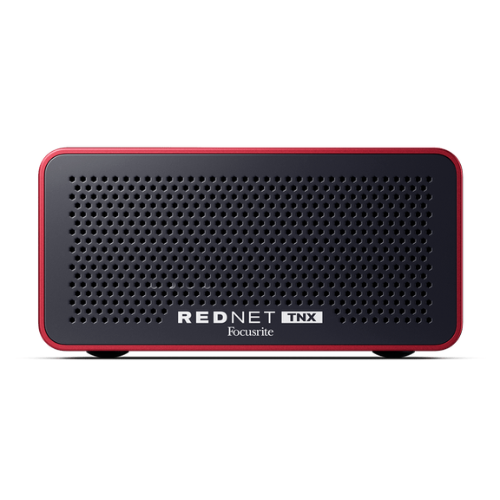

Overview of RedNet TNX
The RedNet TNX from Focusrite is a professional Thunderbolt-to-Dante audio interface designed for recording studios, broadcast facilities, post-production environments, and large-scale audio networks. It provides extremely high channel counts with very low latency over a single Thunderbolt connection.
Key Specifications
- 128 x 128 Dante channels at up to 24-bit / 192 kHz
- Optional Dante Ready™ upgrade expands capacity to 256 x 256 channels at 24-bit / 96 kHz
- 2 × Thunderbolt 3 ports
- Compatible with Windows and macOS
- Supports AES67 and SMPTE ST 2110 network-audio standards
- Dual Gigabit Ethernet (RJ-45) ports with:
- Switched mode
- Redundant network mode for critical applications
- Managed through RedNet Control software
- Thunderbolt ports provide up to 15W power for daisy-chained devices
Main Advantages
- Very high channel density without requiring multiple audio interfaces.
- Ultra-low latency, making it suitable for live monitoring and large recording sessions.
- Native integration into Dante networks, allowing audio routing between hundreds of devices over standard Ethernet infrastructure.
- Redundancy options increase reliability for broadcast and live production.
- Support for AES67 and SMPTE ST 2110 helps interoperability with other professional networked-audio and broadcast systems.
Typical Applications
- Large recording studios
- Broadcast production facilities
- Post-production and dubbing stages
- Live sound systems
- Audio-over-IP installations
- Multi-room recording and monitoring networks
Things to Consider
- It is not a traditional audio interface with microphone preamps or analog I/O. It serves as a bridge between a computer and a Dante network.
- To fully benefit from its capabilities, you generally need a Dante-based ecosystem that may include RedNet interfaces, stage boxes, consoles, or other Dante-enabled equipment.
- The optional 256×256-channel expansion requires a Dante Ready™ license upgrade.
Best For
Organizations that need large-scale, high-resolution audio networking and want a compact Thunderbolt interface capable of handling hundreds of Dante channels with professional-grade reliability. For small studios that only need a few microphone inputs and outputs, a conventional interface would usually be more cost-effective.