
Brain Ultimate Dual-Channel EMG MEP Module
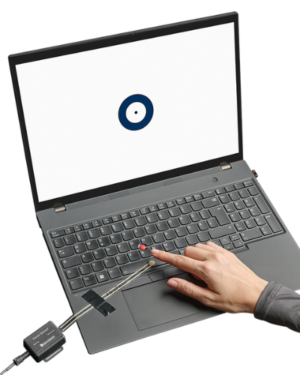
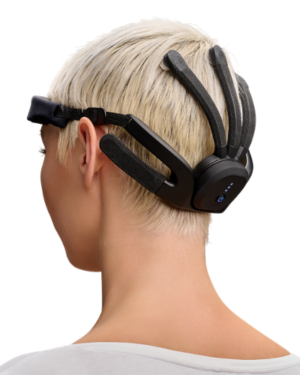
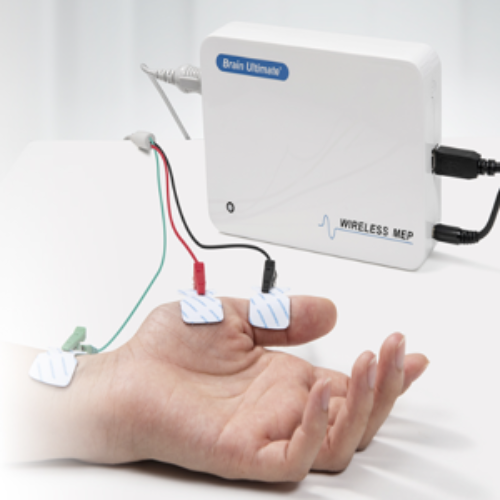
The Brain Ultimate Dual-Channel EMG MEP Module is an optional expansion for the Brain Ultimate M-100 TMS System that enables direct acquisition of electromyography (EMG) signals during transcranial magnetic stimulation (TMS) studies. The module is designed to measure Motor Evoked Potentials (MEPs), allowing researchers to accurately determine motor thresholds and optimize stimulation intensity for individual participants.
Key Features
Direct MEP Measurement
The module records EMG activity from target muscles during TMS stimulation, helping researchers:
- Determine resting and active motor thresholds
- Quantify motor cortex excitability
- Monitor muscle responses to TMS pulses
- Standardize stimulation intensity across participants
This capability is essential in both neuroscience research and clinical research applications involving motor cortex stimulation.
Wireless Transmission
The MEP module uses wireless communication to simplify laboratory setup and improve flexibility.
Benefits include:
- Reduced cable clutter
- Faster experiment preparation
- Improved participant comfort
- Greater freedom in positioning equipment
- Better workspace utilization in compact research environments
Wireless operation is particularly valuable when integrating TMS with additional physiological monitoring systems.
High Signal Quality
The system is optimized for accurate EMG acquisition during TMS experiments.
Features include:
- High signal-to-noise ratio (SNR)
- Precise capture of muscle activation signals
- High sampling rates for detailed waveform analysis
- Reliable detection of small motor-evoked responses
These characteristics help ensure accurate threshold determination and reproducible research outcomes.
Dual-Channel Design
The module provides two independent EMG recording channels.
Bilateral Recording Capability
Researchers can simultaneously record from:
- Right and left hand muscles
- Bilateral upper limb muscles
- Bilateral lower limb muscles
- Multiple muscle groups involved in motor studies
This allows calibration and monitoring of stimulation effects across both cerebral hemispheres.
Expandable Architecture
Multiple modules can be combined:
| Configuration | Recording Channels |
|---|---|
| One MEP Module | 2 EMG Channels |
| Two MEP Modules | 4 EMG Channels |
Using two modules with a single M-100 TMS system enables simultaneous recording from four separate muscle groups.
Research Applications
The Dual-Channel EMG MEP Module is suitable for:
- Motor cortex mapping
- Motor threshold determination
- Neuroplasticity studies
- Brain stimulation research
- Stroke rehabilitation research
- Motor learning investigations
- Corticospinal excitability assessment
- TMS protocol development
- Clinical neuroscience studies
Advantages for Researchers
- Seamless integration with the M-100 TMS platform
- Wireless and flexible deployment
- High-fidelity EMG recording
- Bilateral muscle monitoring
- Expandable multi-muscle recording capability
- Accurate MEP threshold identification
- Reduced setup complexity
Technical Overview
| Feature | Specification |
|---|---|
| Compatibility | Brain Ultimate M-100 TMS System |
| Signal Type | EMG (Electromyography) |
| Primary Function | Motor Evoked Potential (MEP) Recording |
| Channels | 2 Independent Channels |
| Connectivity | Wireless |
| Signal Quality | High SNR |
| Sampling | High-Speed EMG Acquisition |
| Expandability | Up to 4 Channels with Two Modules |
| Applications | TMS Research & Clinical Research |