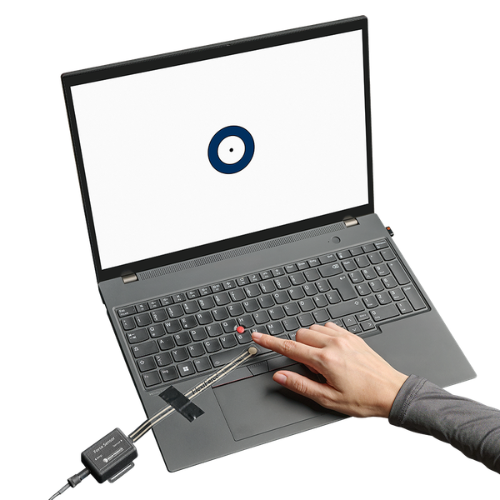
Force Sensor – Precision Force Measurement for Neuroscience and Physiology Research
The Force Sensor from Brain Products is a peripheral physiology device designed to measure changes in the force exerted by research participants during experiments. It enables researchers to capture both the timing and relative amplitude of force-related actions, providing valuable behavioral data that can be synchronized with EEG, EMG, and other physiological recordings.
Overview
Many neuroscience and human-performance experiments require precise measurement of physical interactions such as button presses, grip strength, finger tapping, or force application. Traditional response buttons often record only the occurrence of an event, whereas the Force Sensor provides continuous force measurements, allowing researchers to analyze how force changes over time.
This makes it possible to study not only when a participant responded, but also how strongly they responded.
Key Features
High-Resolution Force Measurement
The sensor measures:
- Relative force changes
- Force application timing
- Response onset and offset
- Force amplitude variations
- Continuous force profiles
Researchers can quantify subtle differences in motor behavior that are not detectable with simple event triggers.
Seamless Integration with Brain Products Systems
The Force Sensor uses Brain Products’ standard 5-pin Binder connector, allowing direct connection to a variety of data acquisition platforms.
Compatible Systems
actiCHamp Plus
- Connects directly to AUX inputs
- Synchronizes force data with EEG recordings
actiCHamp Plus AUX
- Dedicated auxiliary recording platform
- Supports multi-modal physiology experiments
LiveAmp Sensor & Trigger Extension Compact
- Portable force measurements
- Mobile and field research applications
LiveAmp Sensor & Trigger Extension Classic
- Extended physiological monitoring
BrainAmp ExG AUX Box
- Multi-signal laboratory recordings
Research Applications
Motor Control Research
Measure:
- Finger pressing force
- Grip strength
- Movement initiation
- Motor execution dynamics
Useful for studying motor planning, execution, and coordination.
EEG Experiments
Combine force measurements with EEG to investigate:
- Motor cortex activation
- Event-related potentials (ERP)
- Sensorimotor processing
- Brain-behavior relationships
The force signal provides precise behavioral markers that can be aligned with neural activity.
Cognitive Neuroscience
Researchers can evaluate:
- Response confidence
- Decision-making effort
- Cognitive workload effects on motor output
- Reaction force variability
Force measurements often reveal behavioral information beyond reaction time alone.
Human Performance Studies
Applications include:
- Fatigue monitoring
- Skill acquisition
- Performance optimization
- Ergonomics research
- Occupational studies
Clinical Research
The sensor can support investigations involving:
- Motor disorders
- Neurological rehabilitation
- Stroke recovery
- Parkinson’s disease research
- Movement impairment assessment
Benefits
| Feature | Benefit |
|---|
| Continuous Force Recording | Captures detailed motor behavior |
| High Temporal Precision | Accurate response timing |
| Compact Design | Easy experimental integration |
| Standard Binder Connector | Plug-and-play compatibility |
| Multi-Modal Recording | Synchronize with EEG, EMG, ECG, and AUX signals |
| Research-Grade Accuracy | Suitable for advanced neuroscience studies |
Typical Experimental Uses
- Finger tapping tasks
- Button press force measurement
- Grip force experiments
- Motor learning studies
- Reaction time assessments
- Human-machine interaction research
- Neuroergonomics investigations
- Rehabilitation monitoring
Technical Summary
| Specification | Details |
|---|
| Measurement Type | Relative Force |
| Output | Analog Force Signal |
| Connector | 5-pin Binder |
| Compatible Systems | actiCHamp Plus, actiCHamp Plus AUX, LiveAmp STE Compact, LiveAmp STE Classic, BrainAmp ExG AUX Box |
| Application Areas | EEG, Motor Control, Cognitive Neuroscience, Human Performance, Clinical Research |
Summary
The Force Sensor is a versatile peripheral physiology tool that allows researchers to precisely measure force-related behavior during experiments. By integrating seamlessly with Brain Products EEG and physiological recording systems, it provides a powerful way to study the relationship between neural activity and motor performance, enabling more detailed and informative neuroscience, psychology, and human-performance research.