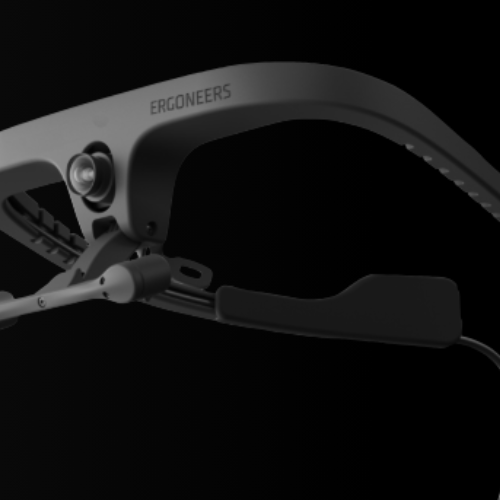

Dikablis Glasses X is a research-grade mobile eye-tracking system from Ergoneers designed for high-motion, real-world studies where conventional eye trackers can struggle with reflections, lighting changes, and rapid head movement.

What makes it distinctive?
Reflection-resistant eye tracking: A unique triangular eye-camera arrangement is intended to maintain tracking reliability under difficult lighting conditions.
Global shutters on eye and scene cameras: Reduces motion blur and rolling-shutter artifacts during fast head or body movement.
Full-HD scene camera: Captures the participant’s point of view with high image quality.
Up to 120 Hz scene capture: Supports smoother visualization of rapid actions and movements.
Wearable over prescription glasses: The lightweight frame and optional head strap are designed for comfort and stability.
Android-controlled mobile workflow: Optimized for Ergoneers’ Prophea.X ecosystem and mobile data collection.
Typical use cases
Driving & Cockpits
- Gaze behavior in vehicles, simulators, and control rooms
- Attention and distraction studies
- Human-factors and ergonomics research
- Training and performance optimization
Sports & High-Motion Tasks
- Soccer, basketball, hockey, golf, baseball, motorsports
- Visual attention and decision-making analysis
- Gaze-path tracking during movement
- Action-sport scenarios with rapid head motion
UX & Interaction Research
- User experience and interface evaluation
- Workplace and manufacturing studies
- Process optimization and safety analysis
- Research in both real-world and simulated environments
Important
Interpreting the 60 Hz vs 120 Hz mention
The marketing text references 60 Hz eye tracking and up to 120 Hz Full-HD POV capture. Those are different measurements:
| Feature | What it means |
|---|---|
| Eye-tracking frequency | How often the eye position is sampled. The text specifically mentions 60 Hz for eye tracking. |
| Scene / field camera frame rate | How often the wearer’s view is recorded. The text mentions Full-HD capture up to 120 Hz. |
For applications that require very fine-grained saccade analysis, researchers often compare sampling rate, latency, accuracy, and synchronization across systems before choosing a platform.
Context
Positioning vs. other mobile eye trackers
Compared with many wearable eye trackers, Dikablis Glasses X appears to emphasize robust tracking in difficult lighting, high-motion capture with global shutters, compatibility with prescription glasses, and integration with the Prophea.X research workflow. Those strengths make it particularly relevant for driving, sports, industrial, and human-factors studies where environmental conditions are less controlled than a laboratory.
Bottom line
Bottom line
Dikablis Glasses X is best viewed as a high-precision, mobile research platform optimized for challenging real-world environments. Its combination of reflection-resistant tracking, global-shutter imaging, wearable comfort, and Prophea.X integration is aimed at researchers and practitioners conducting eye-tracking studies outside the controlled lab.
If you’re comparing it to another system (for example, Tobii Pro Glasses, Pupil Labs, or HTC/VIVE eye-tracking integrations), tell me the specific model and I can provide a feature-by-feature comparison.